
The RC IM Long-Connection Protocol: A Study in Efficiency and Usability
Whether on desktop or mobile, all network communication requires a connection. A long connection is one that is established between a client and server and remains open for ongoing communication. This is in contrast to a short connection, which is created for a single operation and closed immediately afterward. By avoiding the resource-intensive process of frequently creating and releasing connections, a long-connection protocol saves time, reduces overhead, and improves performance.This article explores the core principles of long-connection protocol design and explains the advantages of the proprietary protocol used by RC IM.
Common Challenges in Long-Connection Design
A robust long-connection protocol must address several key challenges.
Security
Security is multi-faceted. It requires channel-level encryption (e.g., TLS) and application-level encryption to protect data in transit. It must also ensure data timeliness and prevent replay attacks, similar to how 5G terminal authentication uses a timestamped sequence number (SQN) for vector verification. Finally, it involves detecting abnormal clients via dynamic authentication keys to ensure all participants are trusted.
Reliability
Reliability depends on maintaining the connection, enabling fast reconnection, and guaranteeing message delivery. Connection stability is achieved through client-server heartbeats, intelligent weak-network handling, and routing users to the nearest point of presence. Fast reconnection strategies minimize overhead, while a Quality of Service (QoS) system ensures messages are successfully delivered.
Low Overhead
Minimizing overhead is fundamental. This involves optimizing the protocol packet size to reduce traffic and designing the protocol for low power consumption during parsing. Efficient application logic and data storage are also critical to achieving high throughput.
Key Design Principles of a Long-Connection Protocol
The design of a long-connection protocol revolves around balancing the needs of security, reliability, and low overhead with the often-competing demands of extensibility and completeness.Common protocols in the industry include:
- SIP: A text-based protocol used primarily in telecommunications (e.g., SMS, RCS). It is highly standardized, which makes it very complete but less extensible.
- XMPP: An XML-based text protocol often used in legacy IM systems. Its verbose nature results in high traffic consumption, but its logical model serves as a useful reference.
- MQTT: A lightweight, binary publish-subscribe protocol widely used in IoT. It features a minimal packet header (as small as 2 bytes), which drastically reduces network traffic, but its application-level business logic is not as rich as other protocols
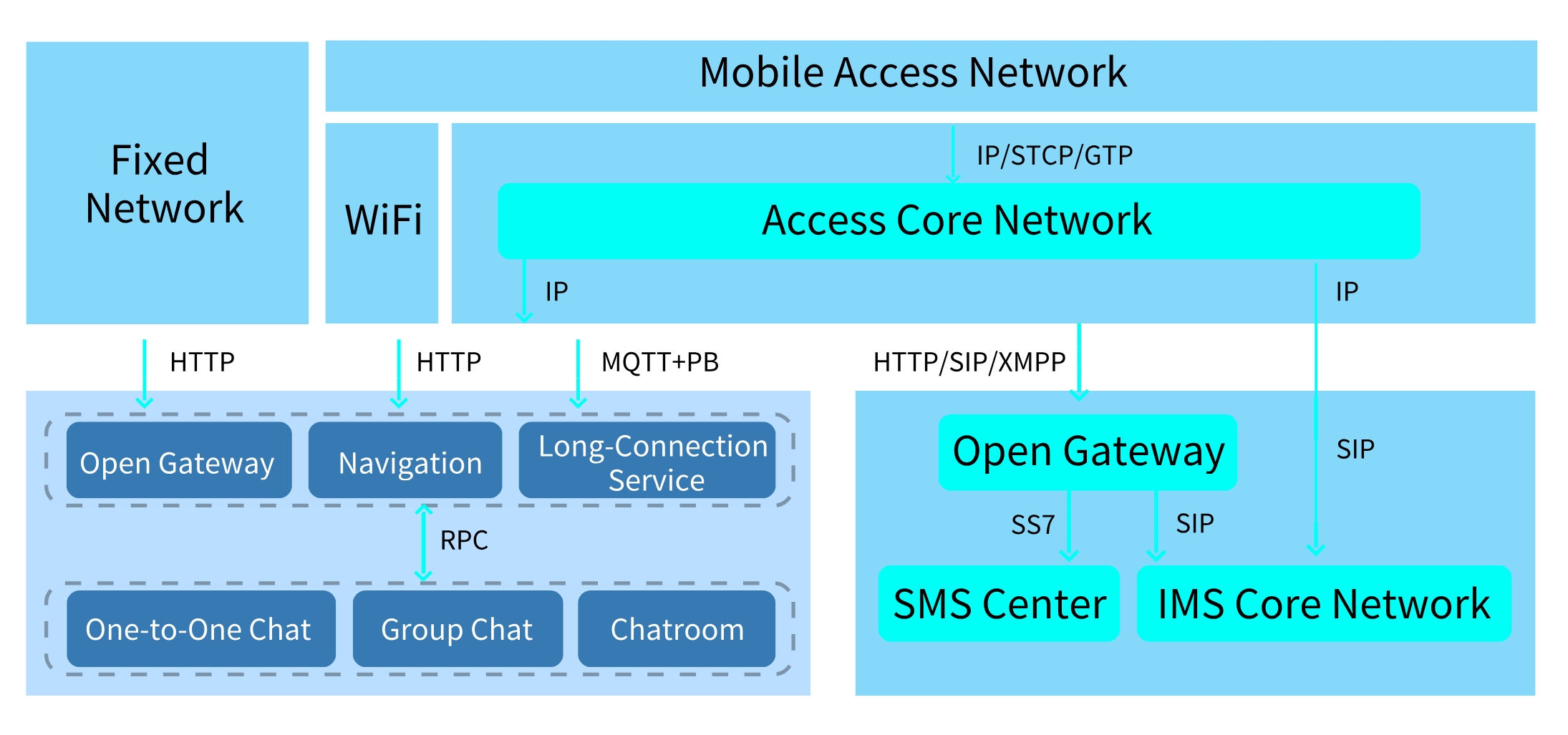
The evolution of transport layer protocols reflects a continuous effort to meet new demands. UDP and TCP provided speed and reliability, respectively. SCTP added high throughput. Most recently, QUIC was developed to provide low-latency, multi-link data transmission. In contrast, application-layer protocols have changed less, with HTTP, MQTT, SIP, and XMPP still dominant in their respective domains.
Conclusion: The RC IM Long-Connection Advantage
The RC long-connection protocol was designed with two primary goals: high efficiency and ease of use.Efficiency is a composite of several factors:
- Security: We use channel encryption (TLS), message body encryption, dynamic authentication keys, and anti-replay mechanisms to provide end-to-end security.
- Reliability: We ensure connection stability with bidirectional heartbeats, a global network of dedicated nodes for low-latency access, and a QoS system that guarantees message delivery even in weak network conditions.
- Completeness: We support multiple message and business types (one-to-one, group, chatroom, etc.) and have implemented full-link message tracing for efficient troubleshooting.
- Low Overhead & Extensibility: By referencing the strengths of standard protocols, we have designed a protocol that maintains low data transmission overhead while providing excellent extensibility through custom message types and business logic.
Ease of use is achieved by providing developers with a protocol that is rich, multi-platform, simple, extensible, and unified.
 预约咨询专属顾问